The Pacific Theater: Critical in the Second World War and Again Today
July 25, 2026 by Lt. Col.(ret) Brian M. DeToy, PhD
a pacific legacy
hawaii: a pacific crossroad
venturing into the pacfic
a pacific legacy
hawaii: a pacific crossroad
venturing into the pacfic
Tom Hanks’ new World War Two series on the History Channel had us enthralled this past weekend. It was not that I discovered a whole lot of new information, but the visuals were stunning! Numerous images and video footage I had not seen before. In general, the “talking heads” were excellent, with only a few head-scratcher comments or interpretations. Although, that is what we historians do – interpret.
I am looking forward to the Pacific episodes later in the series. While I had family members serve in Europe in both World Wars, our family in large part is more one of Pacific service. Several of my mom’s brothers served there in the Navy in WWII and Korea, my dad and brothers served in the Korean War, and my father and two of my cousins served in Vietnam. Sheryl’s father and uncle served in Vietnam, and their cousin was a highly-decorated WWII Army pilot who lost his life near Guadalcanal. Sheryl’s brother was born in Japan, near Tokyo, and I was born on Okinawa. We were later stationed in Hawaii; and I served in California and Washington in my own career.
I am looking forward to the Pacific episodes later in the series. While I had family members serve in Europe in both World Wars, our family in large part is more one of Pacific service. Several of my mom’s brothers served there in the Navy in WWII and Korea, my dad and brothers served in the Korean War, and my father and two of my cousins served in Vietnam. Sheryl’s father and uncle served in Vietnam, and their cousin was a highly-decorated WWII Army pilot who lost his life near Guadalcanal. Sheryl’s brother was born in Japan, near Tokyo, and I was born on Okinawa. We were later stationed in Hawaii; and I served in California and Washington in my own career.
So, the Pacific runs deep in our veins. Our bi-annual Vietnam expedition is absolutely one of our favorites. Especially, as we share the stories of the veterans who come on the trips, as well as those of fathers, uncles, etc. of other guests. We have been leading Pearl Harbor commemoration trips since the 75th in 2016 and beginning next year, in February 2027, we will be leading WWII Pacific expeditions, as well.
Global challenges face the US today, across all oceans and continents. And yet none seem to loom as large, or as dangerous as the Pacific. So much of the world’s wealth, resources and products traverse its expanse. Its bordering American, Asian and Oceania lands contain the seeds of future conflict. Any contemplation of today’s issues is amplified and enriched by an exploration of its past, especially the last major conflict.
Leading Pacific expeditions is a tad more challenging than trips in Europe. The scale of the arena is so vast. And so, before we lead an expedition, we have done our homework, with numerous visits to the scenes of action. From Pearl Harbor, the Punchbowl and Schofield Barracks in Hawaii; to all three main islands in the Marianas – Guam, Saipan and Tinian; to Leyte, Luzon and Corregidor in the Philippines; to Okinawa, Hiroshima and Tokyo in Japan.
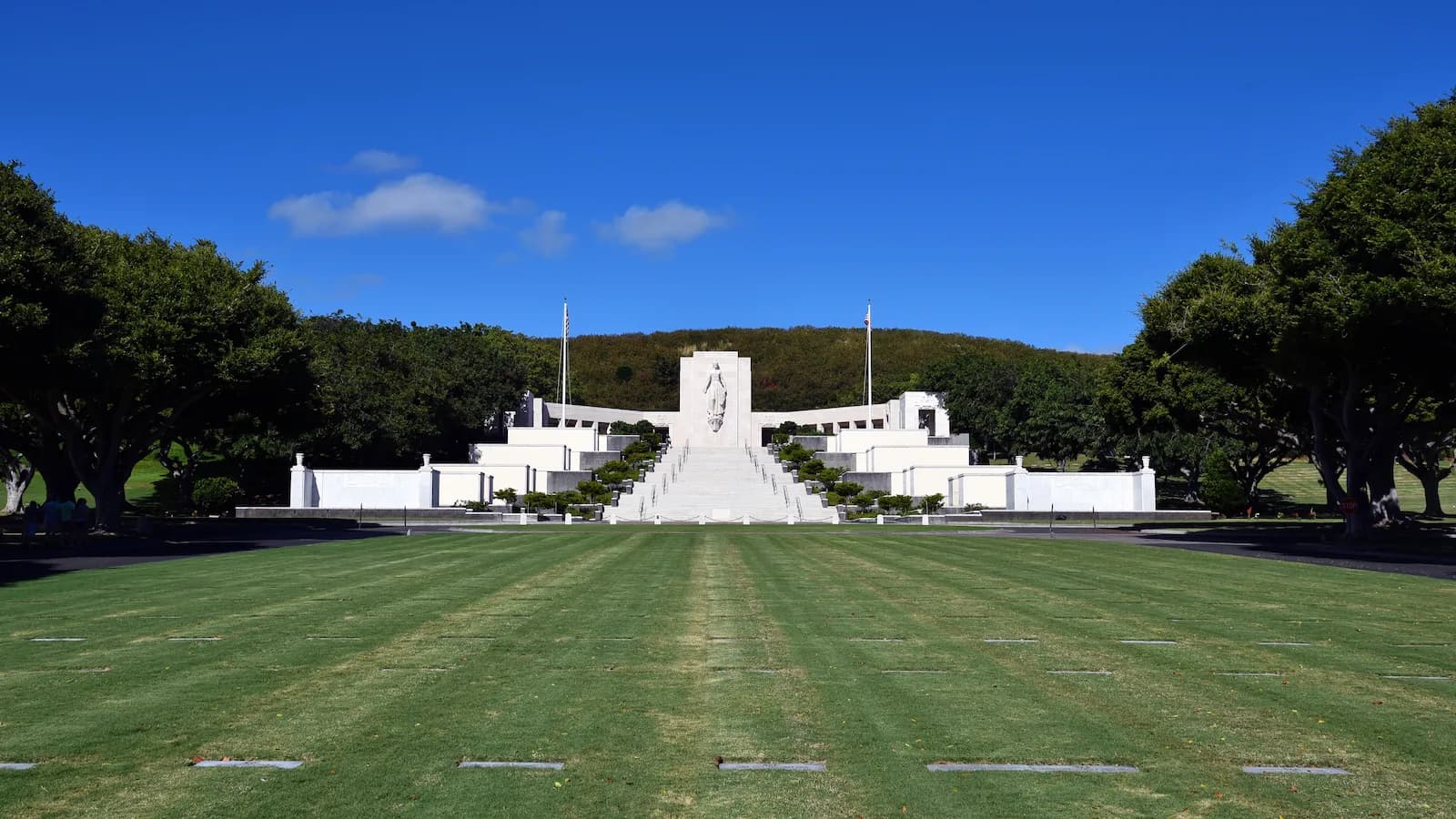
On one visit to the Punchbowl National Cemetery, our group laid a wreath at the gravesite of a sailor killed in a kamikaze attack at Okinawa in April 1945. One of our guests, 95 years old, had been 18 at the time of the attack and the buried sailor was his best friend and mentor. He, and we all, shed some tears. In the Manila American Cemetery, our largest overseas resting place, Sheryl and I always pay our respects to her cousin as his name is on the Wall of the Missing.
In Hawaii, we enhance our expedition with visits to active military bases for specific reasons. On Camp Smith, the home of the Pacific Command, we enjoy a spectacular overlook of the entire Pearl Harbor anchorage to provide the context for our further exploration down among the ships, submarines and planes. The Defense Personnel Accounting Agency lies on Hickam Air Base and a private behind the scenes tour is an emotional highlight of these expeditions. It here, in these labs, where dedicated American personnel painstakingly identify the missing and unknowns from America’s worldwide 20th century conflicts. I have been in the room with twenty bodies of Merrill’s Marauders lying on their tables in the process of identification some 80 years after their loss. As a Ranger, the Marauders are part of my forebears, it was quite emotional. This year, they have exhumed the unknowns from the USS Arizona for identification. We are fortunate to have our access to these incredible sites.
Our flight from Hawaii to Guam brings us to some of America’s farthest shores, the territories in the Marianas Islands. In June 1944, as Ike’s troops stormed ashore in Normandy, the most powerful fleet in world history steamed out of Pearl, bringing a large invasion force to the Marianas. We explore Saipan and Tinian in detail. The former was one of the toughest fights of the war and included the largest Japanese Banzai charge of the entire conflict. We visit that site, harrowing to imagine, and also the cliffs where the Japanese refused surrender and threw themselves off instead. The heights of Mount Tapotchai provide us an incredible vista of both this battle and the nearby island of Tinian.
The symbiotic nature of visiting Tinian and Hiroshima is quite striking. Getting to Tinian is a fun little adventure in a small prop plane of about eight passengers (we take several with our groups) for a ten minute flight over from Saipan. Then, it’s off in a van onto the jungle-clad airfields, which were the world’s busiest in 1944-45 and are once again being repurposed in this modern age of global conflict. A 20-minute drive brings us to the northern airstrips and the two sites where the atomic bombs were loaded onto the B-29s in August 1945. We can look right down into the loading bays. Then, a few days later, after Okinawa and/or the Philippines, we are standing in central Hiroshima, at the Peace Park and Memorial and staring at the devastation wrought by those same bombs. It is humbling.
Having been born on Okinawa, when it still belonged to the United States (we captured in in 1945 and returned it to Japan in 1971), this “last battle” of WWII has always fascinated me. On a visit a few years ago, Sheryl and I Facetimed with my Mom as we watched the Marine contractors tear down our family’s housing from 1961-63 to build new lodgings for today’s servicemen. And so it goes. While the southern part of the island is much more developed than in 1945, you can still get a very good feel for the terrain and the difficulties in attacking the Japanese lines – at places like Hacksaw Ridge (where medic Desmond Doss earned his Medal of Honor), the medieval Shuri Castle and the forbidding Conical Hill protecting the astern approaches. The views from Conical, over the lower part of the island, are well worth the short hike to its summit. Meanwhile, the great American writer, Ernie Pyle, was killed in the Okinawa campaign, and we visit his grave at Punchbowl earlier. Fittingly, since he spoke for the nameless American soldier, his grave is surrounded by “unknowns.”
The Pacific in World War Two. It is where America’s direct military involvement in the war began … at Pearl Harbor and Manila. And it is where the war ended … with the planes taking off from Tinian on their final missions over Hiroshima and Nagasaki.
Join us, in 2027, or 2029 and beyond, as we explore these iconic sites and experience the life-affirming culture and warmth of the peoples who live there today!
Do you want to hear more about:
• Great history and culture?
• New expeditions?
• Our recent expeditions?
Get the latest from EHE with our newsletter!


